German chainsaw course vocabulary: the terms you will hear on the course day
Fallkerb, Bruchleiste, Rückweiche, Schnittschutzhose: the German words used in chainsaw courses in Germany, Austria and Switzerland, explained in English.
Chainsaw courses in Germany, Austria and Switzerland are taught in German, and the safety-critical words are technical: Fallkerb (felling notch), Bruchleiste (hinge), Bruchstufe (step), Rückweiche (escape route), Fallbereich (felling zone), Schnittschutzhose (chainsaw trousers). If you know these before the course day, you can follow the trainer, understand the written check and, most importantly, react when someone shouts a warning. Below are the terms grouped the way a course is usually structured, with sources for the numbers.
Courses and paperwork
| German | English | Note |
|---|---|---|
| Motorsägenschein | chainsaw course certificate | everyday word, not a legal licence |
| Motorsägenlehrgang / Motorsägenkurs | chainsaw course | |
| Modul A / Modul B | Module A / Module B | DGUV training levels: A = basics and small trees, B = trees over 20 cm |
| Lernerfolgskontrolle | assessment (theory and practice) | required at the end of each DGUV module |
| Teilnahmebescheinigung | certificate of attendance | what you show the forester |
| Selbstwerber | self-collector | private person who cuts firewood in someone else's forest |
| Brennholz | firewood | |
| Los | lot | the area or pile assigned to you |
| Raummeter (rm) / Ster | stacked cubic metre | |
| Festmeter (fm) | solid cubic metre | |
| Revierleiter / Förster | district forester | your contact for lots and certificates |
Module A covers at least 16 lessons of 45 minutes over two days, according to DGUV Information 214-059.
Protective gear (PSA)
PSA stands for persönliche Schutzausrüstung, personal protective equipment.
| German | English |
|---|---|
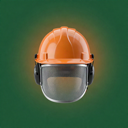
| Schutzhelm mit Gesichts- und Gehörschutz | helmet with face shield and ear defenders |
| Visier | visor (mesh face shield) |
| Schnittschutzhose | chainsaw trousers |
| Schnittschutzklasse | protection class (by chain speed) |
| Sicherheitsschuhe / Schnittschutzstiefel | safety boots with cut protection |
| Handschuhe | gloves |
| Signalfarbe / Warnjacke | high-visibility colour / jacket |
| Verbandpäckchen | first-aid dressing pack |
The Suva lists the protection classes under EN ISO 11393: class 1 for chain speeds of 20 m/s, class 2 for 24 m/s, class 3 for 28 m/s.
The saw
| German | English |
|---|---|
| Motorsäge / Kettensäge | chainsaw |
| Schiene / Schwert | guide bar |
| Kette | chain |
| Kettenbremse | chain brake |
| Kettenfangbolzen | chain catcher |
| Gashebelsperre | throttle lock-out |
| Kurzschlussschalter | stop switch |
| Krallenanschlag | bumper spike |
| Kettenschutz | bar cover |
| Rückschlag | kickback |
| Schärfen / Feile | sharpening / file |
| Tiefenbegrenzer | depth gauge (raker) |
| Sonderkraftstoff | special low-emission, benzene-free fuel |
| Bio-Kettenöl | biodegradable chain oil |
The Bavarian State Forests' course booklet shows these safety features on a labelled drawing, which is a good way to memorise them.
Felling
| German | English |
|---|---|
| Fällen | felling |
| Fällrichtung | felling direction |
| Fallkerb | felling notch |
| Fallkerbsohle | notch floor (horizontal cut) |
| Fallkerbdach | notch roof (sloping cut) |
| Bruchleiste | hinge |
| Bruchstufe | step (height difference behind the hinge) |
| Fällschnitt | back cut / felling cut |
| Stechschnitt | bore cut / plunge cut |
| Sicherheitsfälltechnik | safety felling technique (with a holding strap) |
| Keil / Fällheber | wedge / felling lever |
| Vorhänger / Rückhänger | tree leaning forward / backward |
| hängengebliebener Baum | hung-up tree |
| Brusthöhendurchmesser (BHD) | diameter at breast height (1.3 m) |
| Schwachholz | small-diameter trees (up to 20 cm DBH in Germany) |
The standard measurements, from DGUV Rule 114-018 (October 2025) and DGUV Information 214-046: notch depth 1/5 to 1/3 of the trunk diameter, notch opening 45 to 60 degrees, hinge about 1/10 of the diameter, step about 1/10. These numbers turn up in almost every theory check, but they are no substitute for practising under supervision.
Danger zones and safety
| German | English |
|---|---|
| Gefahrenbereich | danger zone |
| Fallbereich | felling zone (twice the tree height in Germany) |
| Schwenkbereich | swing zone of the saw (about 2 m) |
| Rückweiche | escape route |
| Rückzugsort | safe retreat position (outside the crown's footprint) |
| Kronenprojektion | crown footprint |
| Warnruf: „Achtung, Baum fällt!“ | warning call: "Watch out, tree falling!" |
| Alleinarbeit | working alone (not allowed) |
| Totholz | deadwood |
| Druckseite / Zugseite | compression side / tension side |
| Holz unter Spannung | wood under tension |
| Sturmholz / Windwurf | storm-damaged wood / windthrow |
"Achtung, Baum fällt!" is the call you must recognise instantly; DGUV Information 214-046 has the felling sequence include it before the back cut and again before the tree goes over.
Emergencies
| German | English |
|---|---|
| Notruf | emergency call (112 in Germany, 144 ambulance in Austria and Switzerland) |
| Rettungstreffpunkt / Rettungspunkt | rescue meeting point (numbered) |
| Rettungskette | chain of rescue |
| Erste Hilfe | first aid |
| Druckverband | pressure bandage |
How to learn them
Read one table a day in the week before your course, then use the words: say them out loud when you look at a chainsaw or a stump. The Sägeschein app has a glossary of 60 German terms you can use without buying anything, plus 214 practice questions in German. If you are still choosing a course, start with our guide to the chainsaw course in Germany for English speakers.
German-language theory practice for AS Baum I and II, firewood courses and Austrian or Swiss courses.
Download on the App StoreFrequently asked questions
What is a Fallkerb in English?
The felling notch (also called the directional notch or face cut): the wedge-shaped cut on the side the tree should fall towards. Its floor goes 1/5 to 1/3 into the trunk and it opens 45 to 60 degrees, according to the German accident insurers.
What does Bruchleiste mean?
The hinge: the strip of wood left between the felling notch and the back cut. It is about one tenth of the trunk diameter wide and steers the tree as it falls; it must never be cut through.
What is a Motorsägenschein?
The everyday word for a chainsaw course certificate. It is not a government licence; forest offices ask for it before they let you cut firewood.
Sources
- DGUV Regel 114-018 Waldarbeiten (forest work rules), October 2025 — DGUV (2025-10-01)
- DGUV Information 214-046 Sichere Waldarbeiten — DGUV (2014-05-01)
- Holz machen, aber sicher! (course booklet) — Bayerische Staatsforsten (2026-02-01)
- Schweisser- und Schnittschutzkleidung — Suva (2026-11-20)
- DGUV Information 214-059 (training modules) — DGUV (2018-11-01)